
The NCG board approved a new Ends Policy earlier this year at their April meeting. Our previous policy focused on NCG’s success in delivering programs and services. Our new policy focuses on NCG member co-op success and growth:
NCG exists so that member co-ops are successful, and the total cooperative grocery sector grows in size and scope.
This new policy places the responsibility on NCG leadership to ensure co-op success, as well as define it. As a result, NCG’s success is measured by member success. While we will interpret and define success and growth separately, the policy requires both — we cannot achieve one at the expense of the other. This policy places accountability for member success on NCG, but greater mutual accountability between NCG and its members will support greater success for both.
Following the introduction of the new Ends Policy, we met with numerous NCG staff and co-op general managers to learn more about what this new policy meant to them and how we might define member success and cooperative sector growth. In every conversation with NCG staff and members, the focus was on impact — the impact each co-op has on the health and wellness of their local community. NCG management considered this feedback and the input we received at this year’s Spring Meeting as we drafted our initial interpretations. It was clear to us that co-op success is best defined by the impact of each co-op. B Lab, National Cooperative Business Association (NCBA) and NCG have all published areas to consider when gauging co-op impact. NCBA includes access, business sustainability, community commitment, democratic governance and empowerment, equity, diversity and inclusion, financial security and advancement for workers, and growth. B Lab assesses an organization’s impact on governance, workers, community, environment and customers. NCG’s impact metrics focus on healthy food, healthy people, healthy communities and healthy environment. We believe growth in size is best interpreted as growth in the number of cooperative retail grocery locations and the aggregate retail dollar volume generated by NCG co-ops. Growth in scope directs us to impact new areas of the cooperative grocery economy — expanding our area of operations.
Our measures of progress toward the achievement of this Ends Policy will include both individual co-op and aggregate national performance, and we have established goals for each area that we believe to be achievable in the next few years. It is important to note that we may not have identified suitable measures for each area we want to impact, and we don’t expect to make progress in every area each year. We also believe that interpretations deemed reasonable today may not be reasonable in the future as our industry and markets continue to evolve. We will evaluate and adjust these interpretations and goals as useful to deliver the outcomes stipulated by the policy.
Our current interpretation of member success within this Ends Policy includes:
- Community wellness — development, investment, education and leadership
- Diversity of staff, leadership, membership and suppliers — reflecting the community
- Financial security and advancement of workers — livable wages and benefits and professional development
- Environment — a more regenerative and sustainable food system positively impacting the planet and livelihood of producers
- Business sustainability — growth and profitability
We plan to measure our individual and collective impact in these areas as follows:
Community wellness
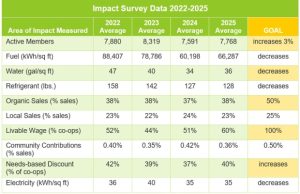
- Cash and in-kind contributions — goal of 0.5% of sales
- Education and outreach events — goal of one per week, per co-op
- Local/regional product sales — goal of 30% of sales
- Community population life expectancy — goal to improve
- Community poverty rate — goal to improve
- Community leadership — number of local organizations engaged by co-op staff and volunteers
Diversity
- Diversity of co-op staff, leadership and membership — goal to match the community
- Diversity of supplier ownership, leadership and staff — goal to match the community
- Access programs — goal of 100% of co-ops providing access to those with limited resources
Financial security and advancement of workers
- Livable wage and benefits — goal of 80% of co-op staff
- Professional development investment — goal of 0.5% of sales
- Wealth building — goal for 80% of co-op staff to save 10% of their income, including employer contributions
- Staff engagement — goal of 80% of staff engaged (as measured by survey tool)
Environment
- Organic sales — goal of 50% of system sales
- Energy consumption — goal of less than 75 kwh/per sf (combined electric and fuel)
- Plastic — goal to decrease the number of SKUs with plastic packaging each year
Business sustainability
- Total equity — goal of 6% annual increase, minimum
- EBITDAP — goal of 4% of sales, minimum
- Same store sales — goal of 3% annual growth, minimum
- Active membership — goal of 3% annual growth, minimum
- Management excellence — management turnover (department manager and up) is less than 10% per year
Our current interpretation of growth of the sector in size and scope includes:
- Co-op retail sales — grow NCG co-ops’ retail sales
- Co-op equity — grow NCG co-ops’ total equity dollars
- Co-op active membership — grow NCG co-ops’ active member count
- Serving more diverse communities — new urban and rural locations and formats
- Supply chain — grow the volume of cooperative production and distribution
We plan to measure our individual and collective impact in these areas as follows:
Co-op sales
- Total system sales — goal to increase by 6% each year
- Retail locations — goal to increase by 10 each year
Co-op equity
-
Value of voting shares, preferred shares, retained earnings and retained patronage — goal to increase by 6% each year
Co-op membership
-
Number of active members (recording a purchase within previous 12 months) — goal to increase by 3% each year (same co-op)
Co-ops serving diverse communities
-
Number of new co-op locations in underserved or low-resource communities — goal of two new locations per year
Cooperative supply chain
- Increase the number of cooperatively owned producers and distributors serving the system — goal to increase by 10% each year
- Increase NCG co-op dollars purchased from cooperatively owned producers and distributors — goal to increase by 10% each year
- Increase the percentage of NCG co-ops’ cost of goods sourced from cooperatively owned producers and suppliers — goal to increase by 10% each year
Much of the data in our 2019 Ends Report will simply establish baselines against which forward progress will be measured. Many of these goals may need to be adjusted once we establish baseline results for each in early 2020.
These interpretations guided the development of our 2020 theme and strategic priorities. We believe both support our ability to make progress on the goals laid out above for member success and sector growth. Our 2020 theme is Future Proof Your Co-op and the strategic priorities guiding our 2020 business plan are:
- Growing co-op sales and earnings
- Improving the diversity of co-op staff, leadership and membership
- Increasing the investment in co-op staff development
- Reducing plastic throughout the system
- Growing co-op consumer membership
- Supporting new co-op food store development through the NCG Development Co+operative
- Increasing accountability throughout the system
We are excited about the potential to sustain and grow our retail food cooperative economy, and we look forward to working with you to ensure a bright future for NCG co-ops.
Let’s go 2020 – Future Proof Your Co-op!