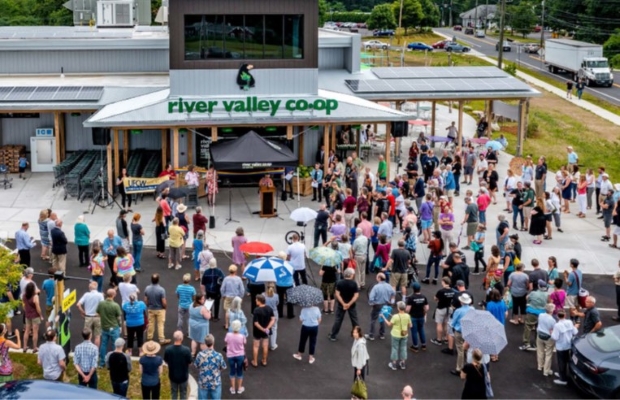

It’s been a year and a half since River Valley Co-op (RVC) opened its second store. The 23,000-square-foot, $20 million store in Easthampton, Mass., opened in July 2021, completing a journey that began back in 2013.
For some time, co-op leadership was aware that they were nearing the point of outgrowing the 19,500-square-foot River Valley Co-op Northampton location, which was feeling the strain of $30.5 million in annual sales. The store was increasingly crowded, the parking lot frequently jammed, and the co-op had conducted multiple owner surveys that indicated a high level of support for expansion. They knew they had to grow, but wanted to do so deliberately, with input from all stakeholders. In 2014, the co-op held a meeting to consider what the co-op’s vision for the future should be. Over 50 people, including board, staff, owners, vendors, local farmers and producer partners were involved.
What came out of that meeting was a concept for another store that would take some of the customer crowding pressure off the Northampton store to improve the store experience there and offer continued growth in job opportunities, support increased purchases from local food producers, and growth in the community reach of the co-op. The new store would also be closer to a significant number of current owners and in a location where RVC could add more owners and customers — about four to eight miles from the current store.
After several years of organizational planning, as well as reinvesting in the current store — which involved updated equipment, a remodel and rebrand, and increased staff development — RVC secured a location for its new store in January 2018, five-and-a-half miles from the Northampton store. The site was a former car dealership, and the property also included asmall building which was leased to a seasonal takeout restaurant with outdoor dining, and a large parking lot. It required the dealership to be razed, as RVC was looking to build a store large enough for to accommodate more long-term growth.
Planning and Financing the Project
Throughout the project, RVC staff worked closely with NCG Store Development. As RVC contemplated site options, they worked with NCG on a pro forma to help size and figure out financing scenarios for the project. Once they found a suitable site, RVC negotiated with the current owner for a year-long due diligence period to allow for an aggressive capital raise.
To help finance the $20-million project, the co-op needed to aggressively raise money from a number of sources. They launched a member loan campaign with an ambitious goal to raise $5 million.
“We didn’t know if our co-op owners would be excited enough to put this level of capital in, but they were,” River Valley Co-op General Manager Rochelle Prunty said. “There was strong community support for the project, which is what this project needed to be feasible.” The average investment was $15,000, but loans ranged anywhere from $2,000 to $200,000.
The co-op also qualified for funding through the New Markets Tax Credit (NMTC) program, with nearly $5 million in forgivable economic development funding. The use of the complicated tax credit syndication structure of NMTC (this was Prunty’s second time working with NMTC) enabled the co-op to own and build a much larger store than would have otherwise been possible.
Construction and COVID
River Valley had the advantage of having Expansion Project Manager Monica Nuñez on staff, who was experienced with store construction. Nuñez managed the construction budget, equipment purchasing and coordination between the general contractor and co-op staff, as well as the co-op’s other project contractors and consultants. She also successfully submitted applications for over $500,000 in grant funding in collaboration with the city and state.
The co-op closed on its financing in January 2020 and planned to begin construction, starting with site demolition in early February. The COVID pandemic hit in late March, “non-essential” businesses were shut down, and new health and safety requirements were required for construction projects.
The project was impacted in several ways. NCG’s programming managers helped RVC make adjustments, notably in the deli, which was redesigned to accommodate a more flexible staffing arrangement during and after COVID. In addition, RVC upgraded the planned HVAC system to improve indoor air quality. Both required some creative workarounds to keep the project from falling significantly behind.
“Fortunately, we had our financing, our materials ordered, the contractor hired, etc.,” Prunty said. “There were occasional work stoppages for a week or two due to COVID and some equipment delays, but we had such a great team, and they figured out how to keep everything going.”
All things considered, the delay was minimal, resulting in the original March 2021 opening moving to July. RVC had a strategic plan to staff the second store with experienced managers from the Northampton store, so they could hit the ground running. This enabled the co-op to promote assistant managers into management roles in the original store. NCG Store Development, corridor staff and programming managers were also on hand to help set the store when it came time to open. Additionally, the co-op gave a boost to the local economy by hiring more than 70 new staff and added 1,000 new members in the first couple months.
The store was designed using green building standards as a guide with attention to energy efficiency and healthy indoor air quality. Local, sustainably harvested timbers were gifted and milled locally for the front entrance. Recycled barn wood was used extensively, and the contractors used low- or no-VOC paints, sealants and adhesives. With financing from solar battery manufacturer EOS Energy systems, and an ongoing partnership with Co-op Power (a consumer-owned energy co-op), RVC now even has on-site solar power generation — both on the roof and in the parking lot — generating 900kW in capacity, making it the first U.S. grocery store that will achieve net zero using its own on-site solar energy production.
Strong Sales and Room to Grow
Ultimately, the results of RVC’s second store project have been incredible. “The Easthampton store opening is going better than projected, and both stores together achieved 45.7% sales growth, a net increase of $14 million compared to 2021,” Prunty said. “Of course, we built plenty more room for our Easthampton store to grow, and now our Northampton store has the capacity to grow again, as well.”
River Valley Co-op is continuing to build sales with about 10% growth overall in its second year. A slightly larger-than-expected sales transfer from the Northampton store to Easthampton and very strong year-two growth at the new Easthampton store means that the two stores are now much closer in volume than expected, so, as always, RVC has made adjustments accordingly.
And while any co-op does most of the heavy lifting for any successful project, Prunty is deeply grateful for the high value that NCG provides through the development process.
“The amount of support they provided was amazing,” she said. “[NCG Business, Real Estate and Store Development Director] John Guerra and [Store Planning Development Director] Larry Polyner, [Center Store Retail Specialist] Tom Snyder and all of the programming managers and department specialists, as well as [Senior Director of Store Development] Dave Blackburn and [Senior Director of Retail Support] Dave Olson — they were all very helpful every step of the way. The store set up and opening support team went all out to help us with this opening and did a fantastic job. NCG has been there for us on follow up support, as well. I can’t imagine doing projects without NCG at this point. I love to see how the support has grown with time.”