

For the past two years, National Co+op Grocers has focused on supporting co-ops’ response to drastically changing market conditions. In 2015, we focused on the changing consumer trends that were fueling rapid growth in our competition, what we called the new normal. In 2016 our focus was on the courageous leadership required by co-op leaders to guide our democratic organizations through difficult and often painful changes.
While this was necessary work and helpful, we know that just minimizing the retailing gap between co-ops and competitors isn’t enough, and it isn’t why many of us chose to lead co-ops in the first place. It isn’t enough to be a reasonable retail alternative to the competition; we need to be fundamentally different. For that reason, we are now focused on measuring and growing our impact and improving our ability to share the difference we make in our communities.
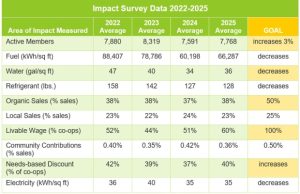
Competitors have tried to co-opt our distinguishing characteristics, knowing that those characteristics appeal to their shoppers. In the new normal, terms like local, organic, natural, sustainable and ethical are no longer enough to set a store apart. For us to distinguish ourselves and the products we sell, we need to convey authenticity. Authenticity demands specificity and data. We need to more accurately understand and measure the impact we have today, and then set goals for substantive improvement going forward. In 2017 we will be asking all NCG co-ops to more accurately measure our impact in five key areas:
Local
- Number of local vendors
- Number of local products
- Local products percentage of sales
Community
- Dollar amount of community donations/contributions
- Percentage of staff earning livable wage
- Ethnic diversity (percentage of staff identifying as ethnic minority)
Health and Nutrition
- Percentage of staff eligible for health care benefits
- Number of classes/workshops/community events
- Participation in low income support programs
Great Food
- Number of organic products
- Organic products percentage of sales
- Fresh department percentage of sales (produce, meat/seafood, deli)
Healthy Planet
- Pounds of food rescue donations
- Pounds of refrigerant leakage
- Electricity use (kWh)
- Heating use (appropriate metric based on fuel type)
Through the goals we set, individually and collectively, we can rally our stakeholders around concentrated efforts to drive measurable and meaningful improvement.
We think co-ops are already better positioned to convey authenticity than our competitors for three main reasons. First, co-ops have done it longer. We are the vanguards of social impact through retail grocery. Second, co-ops can be nimble. In this sense, our small scale is a virtue. It should be easier to measure and communicate our sustainability efforts than it would be at a 300 store chain. And finally, co-ops do it for the right reason. It’s not just a marketing scheme or “green-washing.” The seventh co-op principal, concern for community, makes social impact part of our DNA.
We know the value co-ops bring. We know that value means a lot to our owners and shoppers. In 2017 we will work together to better distinguish ourselves by measuring and increasing the positive impact we have in our communities. We are retooling our sustainability program, Co+efficient, to help you more easily track the areas listed above and this will launch with an update to our Food Co-op Impact Study early this year.
We look forward to working with you this spring to establish common goals in each area and learn how NCG can best support you in growing your impact, measuring your progress and sharing the story!
Author gratefully acknowledges contributions to this article by NCG National Co-op Development Director, Dave Olson.