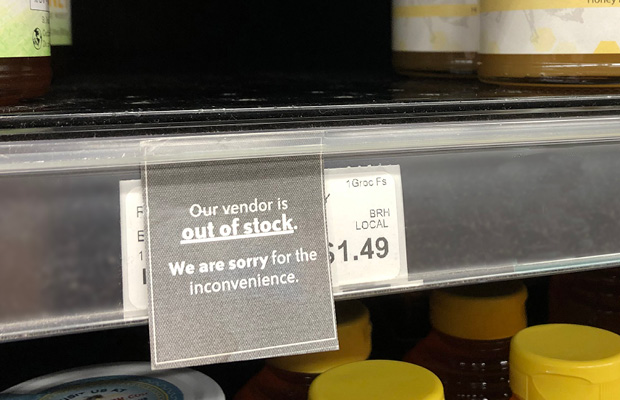

In the past twelve months, co-ops have collected invaluable feedback from 59,608 customers at 113 participating locations through NCG’s Customer Experience (CX) Program. Customers aren’t shy about sharing what they loved about their co-op experience and, importantly, also what they didn’t love.
“Wanted some prepared food, most notably egg salad. Wanted a pint of Organic Valley half and half. Wanted a single bratwurst. Wanted canned clams. None of them were in stock.”
“Today I was after fresh local cream, there was none. Another time recently, the Purely Elizabeth oatmeal, there was none. Last time, a small watermelon. You get the idea.”
“As is typical, we had to make a trip to Aldi to get items you were out of.”
The current state of co-op product availability CX scores is concerning, with just 55% of customers expressing a high level of satisfaction nationally. Today, individual co-op scores range from 36% to 71%. While it’s tempting to place the blame on vendors and distributors for product availability woes, it’s worth noting that the top-performing co-ops on this metric vary significantly in size, sales volume, and geographic location — meaning that they are served by different regional distributors, UNFI distribution centers and local vendors — and affirming that it’s possible to make tangible improvements, irrespective of external influences.
At the department level, product availability is consistently cited as the primary reason for dissatisfaction across the board, as illustrated the chart below.

If customer dissatisfaction with product availability isn’t shocking enough, how about the real impact it has on sales? When customers are asked, “On this trip to the co-op, did you purchase (a) less than intended, (b) as much as intended, or (c) more than intended?”, 54% of customers who purchased less than intended cited out-of-stocks as a reason why – even more frequently than they mentioned price (24%) and quality (9%). These customers will likely go elsewhere to buy what they couldn’t find at the co-op — meaning that dollars intended to enrich the cooperative economy are instead headed to the competition.
The data points to one commonality amongst co-ops with strong product availability scores: even stronger scores on staff availability and staff helpfulness. For many customers, product availability is all about perception. Some customers simply need a hand figuring out where a product is located, or help finding a “co-op version” of a brand or product they are used to buying elsewhere. We know that simply greeting customers proactively and ensuring that staff are available to offer stellar service will meaningfully improve perceptions of product availability.
However, to combat numbers as low as we’re seeing nationally, a focus on service is not enough. Refocusing on the nuts and bolts of retail excellence with tried-and-true strategies for managing out-of-stocks is essential.
It’s time to start counting out-of-stocks daily.
Counting out-of-stocks is a common practice amongst our competitors, but not yet part of the culture at most food co-ops. Fortunately, it’s an easy-to-implement practice that requires only four things: paper, pen, clipboard and a commitment to consistency. Ideally, you can even nix the first three items in favor of a scanning device. NCG offers a plug-and-play spreadsheet template to help you get started, which can be found here.
It is as simple as it sounds: Walk the aisles and count empty spaces. Make this a daily practice. Track the number of OOS by aisle, by department, and storewide.
Review the numbers with buyers weekly and set a goal to reduce the average number of OOSs each week or month. Share OOS tracking at store huddles and stress the importance of product availability for a satisfying shopping experience and preventing lost sales. Use the data above to reiterate the importance of product availability to co-op customers. Remember, this isn’t broad-scope industry data that might apply to your co-op; this is authentic feedback, crowdsourced from the customers we interact with every day, at co-op locations of all different shapes and sizes, from California to Maine.
It takes time to weave a new practice into the fabric of your co-op’s day-to-day workflow — and the best approach is to start now! It may be overwhelming to start counting the entire store today. A reasonable approach is to begin with one department or even one aisle. Each month, add another aisle or department. If you can commit to consistency, before you know it, you’ll be counting the whole store and seeing meaningful improvements to your co-op’s product availability, and in turn, sales growth.
Don’t let schedules or time off get in the way of consistency. While it’s ideal for a store manager, department manager, or buyer to count the areas they are accountable for, this task can and should be delegated to others in their absence to ensure that it’s kept up consistently and covered seven days a week. Consider pairing up department managers as accountability buddies and counting each other’s departments on days off, or empower staff who are most often out on the floor answering customer questions about out-of-stocks to actively participate in counts. By including the whole team, you’ll solidify this practice as one of importance to your co-op. Your customers will thank you for it.
Visit the Operations Preferred Practices page on NCG.coop for additional guidance on out-of-stock prevention and management. For more information on gathering and managing customer feedback through NCG’s Customer Experience program, visit the CX program page on NCG.coop or contact coop.support@ncg.coop!