
In the early days of the Covid-19 pandemic, many communities took note of their local co-op taking the lead by responding in innovative and compassionate ways. Co-ops were among the first in town to erect plexiglass dividers, encourage masking, and facilitate social distancing, living out our cooperative principle of concern for community. There remain many reasons why it’s a good idea to continue to help slow the spread of Covid-19, from mitigating the evolution of new variants to avoiding the individual and societal harms resulting from “long Covid” — not to mention the health, convenience and economic benefit that comes with avoiding communicable illnesses generally.
Today, while Covid-19 vaccines have helped blunt the effects of the virus for many people, this novel virus continues to threaten people whose bodies cannot mount a response to the vaccine due to medicine for an underlying condition or because they suffer from auto-immune disease. Seven million Americans, or about one in 50 people, have a compromised immune system, which means they remain vulnerable to severe illness and death if they contract Covid-19. People with compromised immune systems, as well as their friends and families, continue to take precautions and seek out businesses that take precautions, too.
We know that many people first become interested in healthier diets and seek out food co-ops when they or a loved one experiences a health crisis. So, it stands to reason that our co-op communities count people living with compromised immune systems among their staff, members and shoppers.
We’ve all learned a lot since the early days of the pandemic about how the virus spreads, and what measures are most effective at slowing the spread. Most notably, we now know that the virus is airborne, which means things like keeping six feet of distance between people and installing partial Plexiglas barriers are less effective than originally thought. Armed with evolving science, we also know that there are a range of steps grocery stores can take to help slow the spread of Covid-19 and be more welcoming for people with compromised immune systems.
Be Part of the Solution! Top Ten Steps Your Co-op Can Take
- Think in terms of layers of protection. No one approach is 100% effective. The measures below are additive — the more of them that you can implement, the safer your space can be.
- Upgrade ventilation. Because the virus is airborne, ensuring good ventilation is among the most effective steps you can take. Upgrade your HVAC system to pull in as much fresh, outdoor air as possible and use Merv13 filtration. Add freestanding HEPA air purifiers to office spaces and other enclosed areas where people gather. If upgrading your HVAC system and purchasing air purifiers is cost prohibitive, an inexpensive and effective DIY air filter can be made by duct taping a Merv13 filter to a box fan, and placing them in areas where they’ll be out of the way in high traffic zones.
- Test your ventilation. Once you have your improved ventilation systems in place, it’s important to test their effectiveness on a routine basis. A carbon dioxide detector is a great tool for this, as it’s handheld, inexpensive and provides an accurate measure of how much fresh air is being circulated indoors. Make it a habit by incorporating this tool into daily store audits, so that staff monitor air quality while they’re checking for other operational issues like faulty refrigeration, full trash bins or low stock. If you find high levels of carbon dioxide, it means that conditions are ripe for aerosolized virus to remain present in the air, potentially infecting your staff and shoppers.
- Provide outdoor seating. Provide a welcoming and ample space for people to gather outdoors to enjoy their purchases and mingle with their fellow shoppers.
- Normalize mask wearing. Make free surgical grade masks available at the store entrance and include positive messaging that encourages mask wearing while in the store. Know that mask quality matters: Studies show that cloth masks are effective for about 20 minutes, whereas surgical masks can be effective for 30 minutes and the kind of N95 masks that are available to the general public can be effective up to one hour, 15 minutes. Always require mask wearing when recommended by local authorities or the Centers for Disease Control (CDC).
- Support staff and shoppers who wish to wear masks. People who are immunocompromised themselves, or who have loved ones who are, may need to wear higher quality N95 masks or respirators. Never ask someone to remove their mask or require them to wear a lower quality mask.
- Apply equity, belonging, inclusivity and accessibility (EBIA) concepts. Understand ableism and be prepared to respond when someone bullies or threatens an employee or shopper because they are immunocompromised, or love someone who is. Make sure staff know that they are authorized and encouraged to call a manager or the police if someone is targeted because they are wearing a mask or take other precautions.
- Consider reserving your first hour of business for shoppers at higher risk. If your store closes overnight, less live virus will be circulating in your store during your first hour of business, making it a safer time for immunocompromised, seniors and other people at higher risk to shop. While this may not be advisable for all co-ops or in all communities (particularly if it means that first hour is extra crowded), this is one approach to consider.
- Consider offering online shopping, delivery or curbside pick-up. If financially and logistically feasible for your co-op, this option is especially valued by people experiencing a health crisis, and can help keep them loyal to your store. Consider also working with an online provider who is authorized to accept SNAP online, so that this option is more equitable for more people.
- Understand what CDC data means for your community. Whereas the CDC initially tracked and publicized positive case rates, the CDC’s color-coded map no longer reflects this metric for individual risk. Current CDC data instead measures community risk, which is a measure of the percentage of available hospital beds being used to treat Covid-19 patients. A community’s designation of “green” means that there are enough hospital beds available to the public, regardless of whether or not Covid-19 is spreading within the community. This means that people who are immunocompromised still need to take precautions, and benefit from other people also taking precautions, even when their community is designated by the CDC as “low risk.”
Bonus: Tell people what you’re doing!
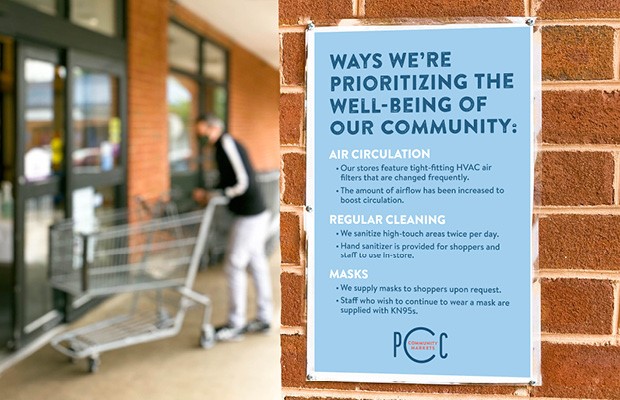
Many immunocompromised people have been subject to bullying during the pandemic and may be wary of asking a business what precautions it is taking. If you are taking some or all of the measures above, inform your shoppers via signage, your website, social media, newsletters and all the ways you usually communicate with your community. Provide customer service staff and those answering the phones with talking points to help them answer questions. Helping to slow the spread of Covid-19 is just one more way that food co-ops can demonstrate concern for community, and stand up for science, justice and health.