
According to data from Food Industry Association’s U.S. Grocery Shopper Trends research, environmental sustainability and economic justice have become mainstream concerns for shoppers. Witness these numbers:
- 47% of Millennials and 44% of Gen Z shoppers look for stores that prioritize sustainability
- 55% of Millennial and 50% of Gen Z shoppers say they choose to shop at stores that treat employees fairly
- 35% of shoppers of all ages are paying attention to supply chain practices focused on fair trade and living wages
- About a third of shoppers of all ages say their shopping is influenced by a company’s carbon footprint
Alongside the rising interest in social and environmental concerns, greenwashing has become a household term. A GreenPrint survey offered the sobering statistic that 53% of U.S. shoppers sometimes or never believe environmental claims made by brands.
So, how can food co-ops avoid getting lumped into that category of stores and brands that are all talk when it comes to environmental and social sustainability? Data.
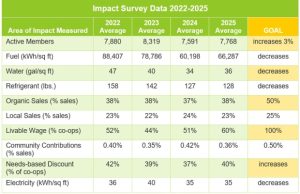
The Food Co-op Impact Survey Helps You Collect Data
Whether your co-op has been completing NCG’s annual Food Co-op Impact Survey for years or you’ve never heard of it before, consider taking this moment while your mind is on it to learn more about the survey and how it can support your co-op’s own reporting and business planning needs.
The survey is completed in Co+efficient, a sustainability database that NCG has invested in maintaining as a free member benefit. Participation in the survey is optional, and any gathered data is a win! To learn more, watch a short video in Co+op U and review the downloadable guides we’ve created to help your co-op collect data for the survey. Feel free to call on support from me and your co-op peers to help you begin to manage data collection in a way that works for your store(s).
By participating in the survey, you will ensure your co-op has time set aside each year with dedicated professional support to collect sustainability data for reporting purposes. Many co-ops tell us that over time, participation gets easier as people learn where to find information and set up systems that support data collection. In fact, there is a series of interviews featuring your co-op peers on Co+op U, where you can get tips for completing the survey at your co-op right now.
Stay Human and Communicate with Transparency
When your co-op understands its current environmental and social performance, you are empowered to set goals and communicate about them. When it comes to greenwashing, customers are less likely to resonate with messages that imply perfection, but they will appreciate if you can clearly communicate where you stand, where you’re going and how you’re getting there.
Sustainability work can be emotionally draining as we are forced to confront scientific evidence of preventable human and environmental devastation. Building our community’s trust and committing to holding our co-op accountable will help us gather the momentum and energy we need to continue to change. Please join your peers and NCG’s advocacy and sustainability team in leading this work at your co-op by participating in our food co-op impact survey.
Share your co-op’s contributions toward NCG’s Ends and be a part of our annual Food Co-op Impact Report by entering and releasing your co-op’s data in Co+efficient by February 28.