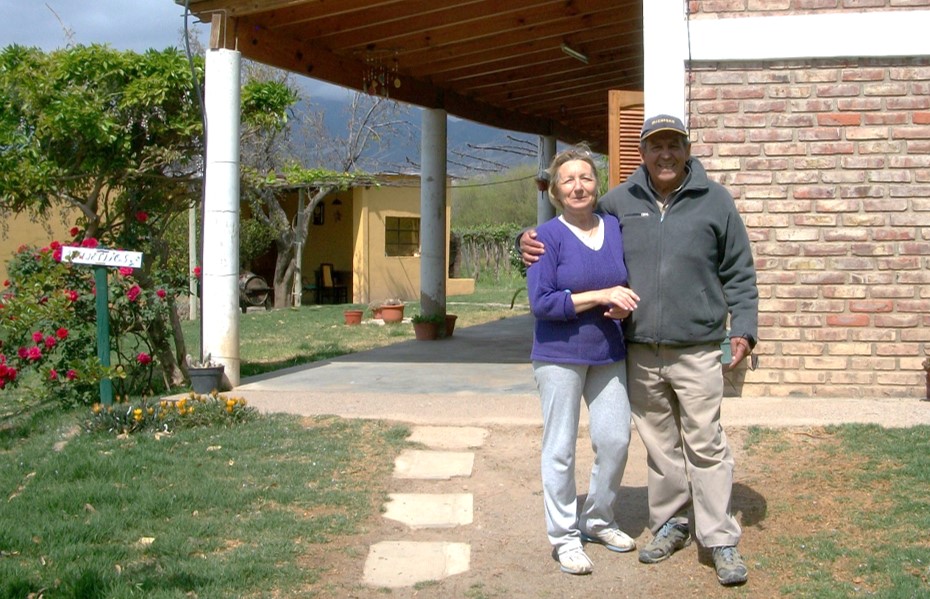

Luis has been cultivating 2.5 acres of land in Famatina Valley in the La Rioja region of Argentina for more than 50 years. He inherited this vineyard from his father, who was one of the first members of La Riojana cooperative. A co-op member himself, Luis uses 100% organic farming practices to grow Malbec grapes as well as walnut and fruit trees.
Wherever I encounter them, farmers who use sustainable and organic methods have such passion for this work and feel a huge stake in caring for the Earth. They are very proud to show you and tell you how it’s done. That feeling of pride is the same around the world.
I met Luis during a recent trip to La Riojana cooperative with NCG Marketing Promotions Programs Specialist Jill Kadrlik and staff members from two NCG co-ops — Rob Drake from Weaver’s Way, who won the 2017 Co+nvergence story slam, and Chris Johnson from First Alternative, who won a drawing NCG offered as part of the UNFI Pacific showcase. Luis and his wife, Anna, invited us into the home he built on the vineyard. While drinking coffee and passing mate around the table, we listened as Luis told us about his family, their vineyard and the benefits of co-op membership and fair trade to his livelihood.
Like Luis, some of La Riojana’s growers are third-generation co-op members; Luis and Anna’s son, an environmental engineer, will take over the farm when Luis retires. The majority of the co-op’s nearly 500 members own fewer than seven acres of land. Cooperative ownership offers these small farmers benefits they would not have otherwise — Luis has access to purchase tools, supplies and equipment at a discounted price; insurance; and no-interest loan assistance. La Riojana’s agricultural experts visit regularly to give Luis advice and the co-op helps find seasonal employees to lend an extra hand during harvest. And, because he produces wine organically, Luis is now a candidate for organic certification as a direct effect of NCG’s 2016 Co-op Month cause promotion, Co-ops Grow Communities, which raised $80,000.
We were inspired to see first-hand the positive impact La Riojana co-op’s partnership with U.S. food co-ops, their owners and customers has on individual growers like Luis and in his community. Through the fair trade premium on our olive oil purchases alone, La Riojana has gained $40,527. They’ve used the funds to start construction on a health clinic in the village Tilimuqui that will serve around 10,000 people in five area villages. Today, the nearest clinic is 25 minutes away by car — but since most people in Tilimuqui do not have a car, routine medical care has been out of reach.
The clinic is La Riojana’s latest effort to bring new life to this impoverished community, following a drinking water supply project and a significant expansion of the local school. Almost half of Tilimuqui’s residents are under age 14, yet children lacked access to a good education and most did not attend secondary school. When it began in 2010, the school had 17 students; now 458 children are enrolled. In addition, the school has created jobs for people living in Tilimuqui. Funds from the fair trade premium made it possible to add secondary classes, including vocational courses that are helping to educate future agricultural engineers and winemakers. The premiums also helped to build a school kitchen and contribute toward the cost of food and bus service for students whose families can’t afford these expenses. Every student who has graduated has gone on to university.
From Luis and his vineyard to the school at the center of Tilimuqui’s community life, it’s easy to see the power of fair trade and co-op to co-op trade, and how interconnected La Riojana’s growers, employees and neighbors are as a result. The La Riojana story is one you can feel proud to share at your co-op — during Co-op Month and Fair Trade Month and all year long. The La Riojana support materials, signage and a short video on NCG’s website can help you tell the story.