
Goal setting is a common and often effective means of driving progress toward reaching sustainability goals. In 2016, NCG co-op designated representatives worked with NCG’s sustainability staff at a national meeting to establish collective impact goals in key areas. NCG co-ops set seven goals to aim for by 2020 and committed to sharing information with each other about what works in pursuit of these goals.
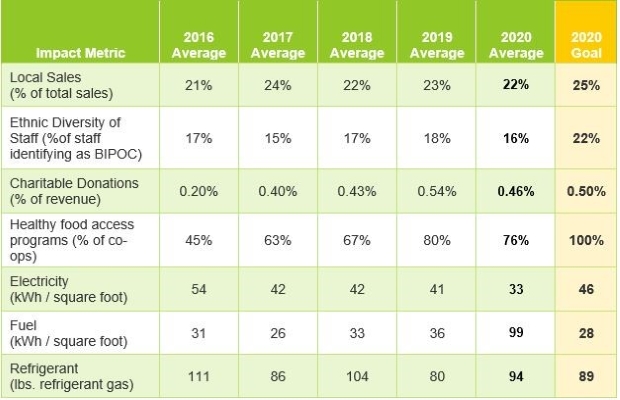
In the chart above, you can see how data stacks up over the past five years, including the 2020 impact data that we collected in January, compared to our collective impact goals. Because our dataset fluctuated year over year, this chart does not tell a wholly accurate story, but it does allow us to draw trendlines and assess whether we are moving in the right direction, collectively.
How Did We Do?
We met our electricity goal, and although we didn’t meet any of the other benchmark goals in 2020, looking at trendlines for the data across five years, we are headed in the right direction in many areas.
- Co-ops have shown tremendous progress in adoption of Healthy Food Access programs — with three out of four co-ops reporting offering a program in 2020, compared to fewer than half when we set our goal in 2016.
- We’ve also come a long way with charitable donations as a percent of revenue, with reporting co-ops coming very near our collective goal to donate 0.5% of revenue annually, more than double the average of what co-ops reported they gave to charity in 2016.
- Electricity use is another win — co-ops have made consistent progress driving down electricity use, where we’ve exceeded our collective goal of 46kWh/square foot every year since 2016.
- Likewise, refrigerant gas use has been on an overall decline since 2016 and if this trend continues, we are on track to see 89 pounds as the high water mark soon.
- In the neutral zone, local sales have remained pretty flat over the past five years, trending slightly positive.
The remaining areas are ones where co-ops could benefit from additional attention and consideration.
- Ethnic diversity of staff, where we asked co-ops to identify the percentage of their staff identifying as Black, Indigenous or Persons of Color, has lingered around 17% without statistically significant change over the five-year period. NCG is investing in resources to assist co-ops in moving these numbers closer toward a goal of reflecting community demographics.
- Fuel use is another area where we have seen the trendline go up over the years, rather than down. While we don’t have enough data to speculate why our 2020 average was nearly three times where we started in 2016, a simple explanation could be that our dataset included more co-ops from regions with cold winters in 2020, or that COVID-19 related adaptations resulted in greater heat loss (e.g., keeping doors and/or windows open for airflow, running fans, etc.).
Where Do We Go from Here?
We are grateful to all co-ops that participated in our collective impact goal-setting effort! Thank you for the inspiring stories you’ve shared and the changes you’ve made in pursuit of operational efficiency, environmental and social sustainability.
While we will not be setting additional goals at this time, we will continue to ask co-ops to track a set of core metrics annually. NCG’s advocacy and sustainability team is reviewing our core impact metrics and will make adjustments based on co-op priority areas, industry standards and NCG’s reporting needs.