
Newsletters have long been one of co-ops’ primary communication vehicles to their owners, and a strategy that both reinforces loyalty and differentiates co-ops from competitors. At the same time, producing newsletters can be a big financial burden – postage expense alone can cost thousands of dollars annually – and require a significant investment of time by co-op staff and even board members.
As you look for ways to increase efficiency in this highly competitive environment, NCG has developed two new resources designed to encourage co-ops to adopt more streamlined approach to newsletter communications:
Preferred Practice
In brief, NCG’s new newsletter preferred practice recommends that co-ops:
- adopt a quarterly production cycle for printed newsletters
- focus on seasonal themes
- establish guidelines for content type and length, and
- move away from postal mailing in favor of in-store distribution to all interested shoppers.
Strive for newsletter content that appeals to both current and potential shoppers, with a tone that is informative, educational and approachable, and a professional design that is consistent with your co-op’s brand identity.
We also recommend that co-ops send a weekly or biweekly e-newsletter to allow for better communication of Co+op Deals and other time-sensitive information that is not suited for a quarterly newsletter. Make e-newsletters brief and to the point, with content that drives traffic into your store, such as a sales promotion or coupon.
For well-coordinated and more effective messaging, repurpose newsletter content across other vehicles, such as the co-op’s website, social media channels and in-store signage. For example, demos might use “As featured in the newsletter!” signs for foods with featured newsletter recipes.
Design Templates
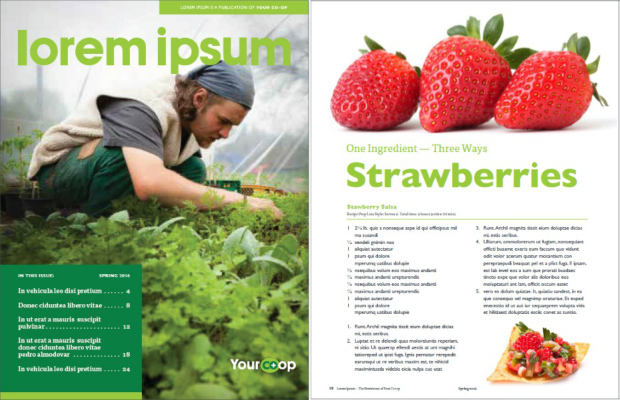
The second resource is a new library of newsletter template design files (available as InDesign files) available to help co-ops design more attractive and concise newsletters. The library includes multiple cover options, interior page configurations and type styles to match the content types recommended in the preferred practice – including messages from the co-op and co-op board, short articles, feature stories, recipes and an event calendar. Like any template, these configurations are designed to be flexible in layout but any changes to design must be approved by NCG’s marketing department.
By adopting these resources, we’re confident that co-ops can communicate with shoppers and owners more efficiently and with greater impact.