
You may be one of the people helping to complete your co-op’s Food Co-op Impact Survey — HR has an important role to play! You may also have questions. We certainly did, and we put them to NCG Sustainability Programs Manager Cole Hawthorne. Cole is passionate about the survey and has plenty of insights to offer. Read our Co+efficient Insights Q&A and then share it with others at your co-op who might help complete the survey!
Edmond: When completing the Food Co-op Impact Survey, what are co-ops most surprised to discover?
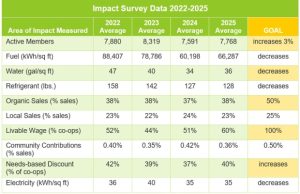
Cole: One of the coolest surprises I hear about is how some co-ops use the data they gather for the Food Co-op Impact Survey in their own reporting for things like Ends goals or to their boards. Many cooperatives don’t realize how participating in this survey actually helps their own goals.
Edmond: February 2026 seems “worlds away” at this point. With that completion date so far off, do you have any advice for those co-ops that are considering completing the survey for the first time?
Cole: While co-ops can gather and enter some information (like utility usage) throughout the year, most of the information they will put into the survey will not be available before the year is over.
Here are a few things co-ops can do to prepare:
- Watch Completing the Food Co-op Impact Survey with Co+efficient on Co+op U, and while you’re there, check out the other recorded webinars and peer interviews we’ve collected to help co-ops with the survey.
- Look at the survey questions. You can find the 2026 reporting cycle questions (collecting 2025 data) on the NCG website.
- Review the Food Co-op Impact Survey resources available on the NCG website. Reading Six Questions about Co+efficient and Impact Reporting is a great place to start.
- Take a look at the guides available on NCG’s website and determine who in your co-op is able to collect the data for each question. Typically, it is a combination of HR, marketing, POS and finance staff.
- Reach out to me, Cole Hawthorne, with questions about the metrics.
Edmond: Which metrics take the most time to gather data or complete in the survey? Don’t hold back. Give us the tea!
Cole: While it varies by co-op and what they currently measure, there definitely are some tougher questions to find information for. Gathering information on local or organic sales can sometimes be particularly tough, if you don’t have the ability to track those things with your POS system. But there is a series of resources available on NCG’s website that walk through gathering data for specific metrics, which can be really useful.
Utility data can also take a lot of time to compile, when going through invoices from providers. In Co+efficient there is an option to enter the data month by month and the system will add the transactions for a grand total usage, or the data can be entered once for the whole year if that is easier.
Edmond: What’s the benefit to the person who completes the Impact Survey? What’s a personal benefit (beyond the co-op benefit)?
Cole: On a personal level, it is an opportunity to get more experience working with sustainability data. This industry is getting increased attention, and having experience working with sustainability analytics is in demand. Additionally, the data can be useful to someone’s personal role at the co-op. Having access to sustainability information across departments at the store can be an asset when considering sustainability goals, identifying savings opportunities, investing in retrofits, thinking about new programming, etc.
Edmond: Best practices for seeing the Impact Survey through to completion?
Cole: Start early and stick with it! Communicate your needs and reach out if you would like support. I am available and happy to work one-on-one with folks to assist.
There is no one right way to complete the survey. Some folks don’t track certain metrics, but any data we are able to gather collectively strengthens the effectiveness of the overall data. This is a big lift, but the more data we have, the more useful the survey becomes. Thank you again to our readers in co-op land for all your hard work on the survey!
Edmond: What’s your favorite Co+efficient user story?
Cole: Ah! There are lots of good ones. I think my favorite stories are ones where co-ops have been able to use the data to invest in sustainability projects at the store. Over the past years, for example, a co-op used their data to support a grant application for a composting worm bin (so cool!).
Learn more by going to Co+op U to take the course Completing the Food Co-op Impact Survey with Co+efficient.