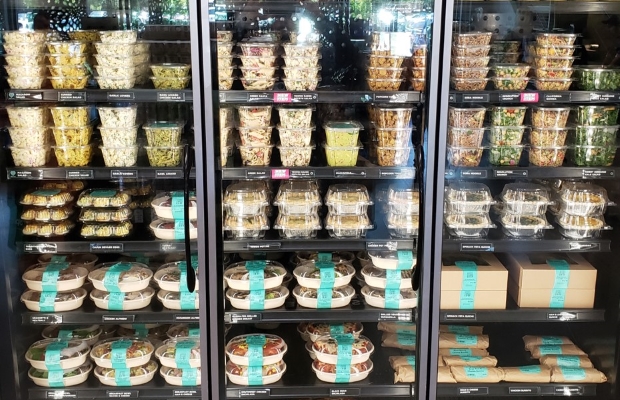

Is your grab and go section reaching its full potential? Since the beginning of the pandemic, grab and go has been the the top breadwinner and main support of sales for the deli. Customers have switched shopping patterns and are more comfortable buying pre-packaged menu items, accepting a wider variety of options. Stores that have been proactive with their grab and go sets are seeing record-breaking sales, even compared to pre-COVID levels.
Monitor what’s selling and what isn’t
Before you begin, you’ll need to analyze current grab and go item movement to identify exactly what is selling and what isn’t. The goal is to give customers what they want and to have those items in stock all the time. Sacramento Natural Foods Co-op discovered they were having trouble keeping their sandwich case full throughout the day. To better understand why, they took an active approach and conducted an inventory four times daily. The team used this data to determine where sales were being missed because items were out of stock, and then changed their production quantities to meet demand.
Expand your offerings
Next, look for ways to expand your category set by surrounding the most popular items with complementary ones. At Sacramento, this was accomplished by offering half-sandwiches and merchandising them near small composed salads in the grab and go case. This pairing naturally prompted customers to create their own combo meals. For shoppers looking for a quick and inexpensive lunch, the price of a whole sandwich plus salad or soup had been a barrier; the half-sandwich option brought the price below $10. The change was easily executed because the variety of sandwiches is the same — Sacramento simply makes more whole sandwiches and cuts them in half. Another way to expand your offerings is to translate the ingredients of your top-selling sandwiches — ones you already know customers are buying — into wraps, which are an on-trend item currently.
Promote new menu items
Two of the most effective tactics to support the roll out of new items are signage and sampling. Providing informational signage at the shelf is key; cross-merchandising signage throughout the store is also helpful, especially on items made with seasonal produce ingredients. For example, place a sign next to your grapefruit display — “If you like this grapefruit, try our new seasonal grapefruit salad in the deli” — to entice shoppers to make a grab and go purchase. Offering samples of that grapefruit salad during the first two weeks after introduction will drive sales, too. Ensure that staff from the deli, marketing, merchandising and other relevant departments work together to coordinate these promotional efforts.
Compare sales before and after
After adjusting stock levels or adding new items, you’ll want to collect movement data for a few weeks to compare sales before and after — in both units and dollars — side by side. This analysis will help you make par adjustments to fill out of stocks on the most in-demand items as well as identify unpopular items that could be removed from the menu. Give careful consideration to vegan, vegetarian, gluten-free or other specialty items; although unit sales may be small, they can be important to your menu offerings.
Sacramento Natural Foods participated in our recent Quarterly Deli call, and they are currently achieving almost $30,000.00 in grab and sales per week. Pre-pandemic, they were under $20,000.00 per week with the same space allocation. The team took the lessons learned on their reset of their cases and expanded the offering of meals and accompanying sides dishes to respond to pandemic demand. It’s likely that even with the expansion of selection throughout the department, as the pandemic winds down, sales will remain at or near the current levels in grab and go.
Fine tune your menu
With data in hand, you can continue to fine tune the menu of your newly reset grab and go section. When trying to determine what foods to offer, look at trends. SPINS is a great source of industry data and national trends, including information about similar-size delis around the country, not just co-ops. Don’t be afraid to take some measured, monitored risk — try new things, analyze the results, and adjust as needed to reach your sales goals.
Tools and resources
NCG offers a number of resources to aid you in executing a grab and go reset. The Grab and Go Playbook is your first stop for comprehensive operational information, along with related forms and templates. The prepared foods retail specialist in your corridor can also provide valuable assistance and answer questions about grab and go resets. For recent insights from NCG’s retail deli support team, find the recordings and minutes from the three Q2 regional prepared foods calls here. Finally, tap into the network of peers at other co-ops across NCG to ask what works well in their grab and go section, to request photos or recipes, and find support.
- Mark Papendieck – Eastern Corridor Prepared Foods Retail Specialist
- Meredith Provance – Central Corridor Prepared Foods Retail Specialist
- Ken Wallace – Western Corridor Prepared Foods Retail Specialist