
A big thank you and a hearty congratulations is in order — together NCG food co-ops broke a record for best participation ever in the Food Co-op Impact Survey this year! We collected responses from a total of 139 co-ops, or 84% of our membership. Thank you for leaning into cooperation to complete the survey, and congratulations on achieving the most accurate picture of our combined social and environmental impact ever!
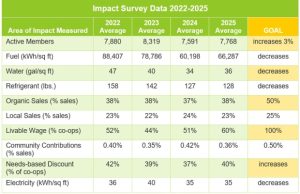
While the 2024 Food Co-op Impact Report shares some of the impact data co-ops reported on this year, it doesn’t provide a complete picture of year-over-year survey results and emerging trends.* In the chart above, you can see how some of the survey questions stack up over the past three years compared to goals we have set for our community of co-ops as a whole.
How Did We Do?
We met our fuel, water, electricity and refrigerant goals for 2024, and although we didn’t meet any of the other benchmark goals in 2024, looking at trendlines for the data across three years, we are headed in the right direction in many areas.
- Local Sales trended up this year, with 24% of sales coming from local products and the average co-op working with 175 local producers. NCG co-ops in 2024 were well ahead of the average food retailer operating less than 10 stores, which reported partnering with 41 local farms, according to 2023 data from FMI. SPINS data suggests that for conventional grocers, local products make up about 2% of total sales.
- Community Contributions were up by .07% of total sales between 2023 and 2024.
- Fuel Use intensity is another win. Co-ops made progress in 2024, decreasing fuel consumption by 10%. While 2022 was a “benchmark” year (in which we established our baseline for calculating fuel use), so far, we are seeing a consistent trend and NCG co-ops will meet our goal to collectively decrease fuel use year over year.
- Water Use intensity was another area where co-ops made progress in 2024 from the benchmark year of 2022, when we established a baseline for water usage as calculated per square foot. Collectively, co-ops’ water use decreased by almost 15%.
- Also worth celebrating, Refrigerant Gas use has been on an overall decline since 2021, decreasing by 32%. Refrigerant gases are among the most harmful to our atmosphere and focused attention on decreasing them is among the most important things grocers can do to slow climate change.
- Electricity Use intensity has continued to decrease since the benchmark year of 2022, when we began tracking resource use per square foot. Co-ops can access resources to reduce electricity usage on the NCG website.
- In the neutral zone, Organic Sales have remained pretty flat over the past three years, trending slightly down. In 2024, 37% of NCG co-ops’ annual sales came from organic products. Compared to conventional stores where just 3% of sales were from organic products, and natural retailers at 24% of sales, the NCG system on average is a high performer.
- The number of co-ops reporting that they offer all employees a Livable Wage increased over last year, bringing us up to 51% of co-ops reporting that they pay 100% of staff a livable wage or according to their union contract. NCG offers support and resources for co-ops interested in the Co-op Livable Wage and Benefits Model.
Co-ops appear to be struggling to make improvements in the following areas:
- Co-ops had a decreased average number of Active Members in 2024, which could be due to a variety of factors including new co-ops opening and a larger sample size, but we have identified this as an area for continued growth.
- The percentage of co-ops offering Needs-Based Discounts dropped to 37%, suggesting that NCG as a system is trending down in this area. NCG offers a preferred practice resource for co-ops interested in offering a needs-based discount.
Gratitude, Collaboration and Inspiration to Keep Going
Thank you for dedicating time and energy to collect and share data that helps NCG better understand where to invest resources that can help co-ops improve their social and environmental sustainability.
Co-op staff who work on the Impact Survey or have sustainability-related responsibilities are invited to join me on monthly sustainability staff catch-up calls, provided that they have approval to do so during working hours. On these calls, we come together to collaborate, build community and encourage each other to make the changes in our stores that make a difference to our communities and the world.
* NCG reports to our board of directors and co-op designated representatives (DRs) on all metrics annually in the annual NCG Ends Report. Additionally, Co+efficient users can use the dashboards feature to analyze their co-op’s year-over-year progress and compare progress with their peers.