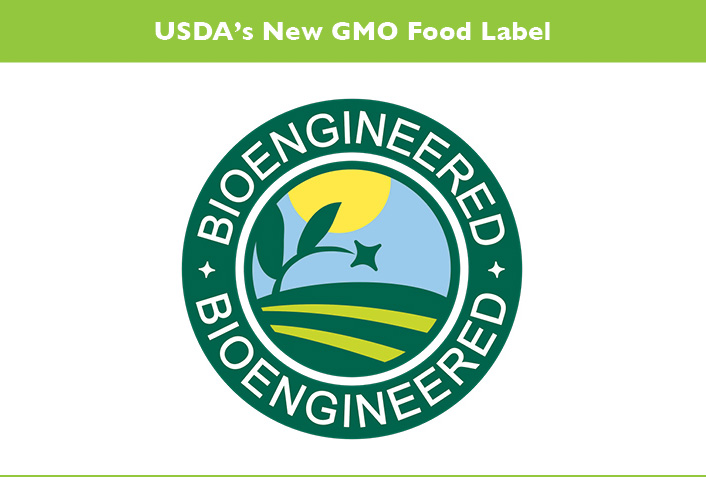

Have you seen one yet? Though at times GMO labeling has seemed a distant prospect, new mandatory labels are finally here and will be visible soon on a product near you.
How soon? Although companies have until Jan. 1, 2022 to be fully compliant with labeling rules, the regulations have been in effect as of February 2019 so it’s likely that you will start to see products bearing USDA’s Bioengineered (BE) food labels any day now, if you haven’t already.
For food co-ops, the new labels mean two things: new federal requirements to label some foods that aren’t labeled by a manufacturer and, of course, customer questions! We’ve put together a general Bioengineered Food Labeling FAQ for co-op staff that engage with customers on a regular basis and we are developing recommended labeling protocols for those who work in departments where packaging and repackaging of products happens (bulk grocery, deli/bakery and produce for example).
If your co-op is interested in sharing information about the new labels in your owner newsletters, websites or social media, check out our article, A Label of Contents: GMO Labels Explained on Grocery.coop.* This article explains, in a straightforward way, what customers can expect to see including important information like…
- What happened to the term GMO? Despite widespread familiarity with the terms GMO, genetically engineered and genetic engineering, the labels use terminology identified in the Bioengineered Food Disclosure Standard—bioengineered—to describe a food that has been altered in a laboratory to possess a certain set of traits. Although NCG advocated for labels that use the familiar GMO and genetic engineering terms, USDA now requires that labels use BE and bioengineering. To reduce confusion, NCG will adopt these terms when referring to these foods going forward.
- What does the label look like? There are several legal options companies can choose from when labeling their products: a written on-package disclosure, a round symbol, a digital disclosure (QR code or web address) or a number that customers can call or text for a disclosure. This will likely be a good area to focus staff training on—especially if you’re seeing the digital options in use around your store. Customers who do not have a cell phone or reliable internet access are unlikely to be able to access the bioengineered status of the product via those methods.
- How is a bioengineered product defined? According to the regulations, a product must be labeled if it contains detectable bioengineered DNA in its final form. But dust off your chemistry books, because this definition excludes highly refined products like sweeteners and oils that lose their original DNA during processing. So, high fructose corn syrup derived from bioengineered corn may not trigger labeling, nor would vegetable oils derived from bioengineered soy. There are other exceptions, as well.
What is NCG’s position on the new requirements?
NCG has advocated for GMO labeling since 2011, and we are disappointed that these regulations do not provide for full transparency. Although the exemptions in this rule mean that these labels do not achieve the level of transparency NCG and many consumer rights advocates had hoped for, we take heart in the fact that many companies have heard from their customers and food co-ops when it comes to this issue.
NCG circulated a letter to all of our vendor partners in March of 2019 that conveyed our desire to see companies label all of their products to the full extent of the law (including for exempt ingredients like refined oils and sweeteners) using the on-package written disclosure method (the most transparent option). Our collective influence as buyers holds sway with manufacturers, but in the end, it is a decision each company will make on their own.
Can we strengthen these requirements?
While the movement has likely exhausted legislative opportunities to improve transparency, NCG will continue to work within our supply chain to encourage transparent and straightforward labeling. Consumer research tells us that people expect and appreciate transparency about where, how and from what their food is made. The trend is for companies to become increasingly forthcoming about these matters. Companies that champion their customers’ right to know how their food was produced will likely choose the on-package written disclosure or symbol, and use USDA’s voluntary labels to the extent allowed by law, even if their product is exempt. For products where disclosure is prohibited by law, some companies may even join consumer groups to legally challenge those exemptions.
*Did you know that your co-op can use most content from Grocery.coop in printed materials with proper attribution? Contact Liz McMann for details.