
The first half of 2020 presented unprecedented challenges in the grocery industry. Food co-ops across the country have risen to the task, though, keeping their shelves stocked and their staff and customers safe — all while continuing to support their local communities in numerous ways. We have been sharing examples of co-ops’ inspiring and uplifting ideas, and in case you missed some of these stories, here’s a retrospective. Read all of the stories in the On Common Ground section of this website.
Virtual Events
Co-ops are using technology and getting creative with their events. When it wasn’t possible to hold their annual Community Supported Agriculture Fair in typical fashion this year, Seward Community Co-op in Minneapolis decided to go virtual. The CSA Fair has been a cornerstone event for Seward and its community for 19 years. So, this year, they featured over 20 local farms on social media throughout the month of April, highlighting their CSA shares through videos and Q&A sessions. The virtual CSA Fair provided all the information users needed to pick the share that was best for them.
Outpost Natural Foods Co-op in Milwaukee, Wis., celebrated their 50th anniversary with a Virtual Birthday Concert Series. The concerts were hosted by a local radio station and Wisconsin Music Ventures. The performances, which took place from April 23-26, featured rock ‘n’ roll, classical and “Midwestern” acts and streamed on Facebook.
A number of co-ops have also ventured into online classes rather than suspend their education programs altogether. Boise Co-op in Idaho offered a class called Virtual Vino!, wherein online participants could “travel” to various winemaking destinations. The class hosts discussed various wines from the region and suggest pairings. One class featured Argentinian wines paired with a cheese that was one of the co-op’s featured sale items. As a bonus, they offered featured wines at a 15% discount.
Weavers Way in Philadelphia came up with the idea for an “Art Make-In” class, led by a local artist. The free class is held on Zoom, so participants could enjoy one another’s company while crafting. Both children and adults were invited to use whatever materials they had at home to draw, paint, collage, sew, etc., their creations. Past “Make-In” themes have included a project that celebrated parents, ancestors and other heroes, and an “Interdependence” Day project that focused on the ways in which people are connected.
Online Elections and Meetings
Since large gatherings have generally been prohibited due to the coronavirus — and may continue be for some time — co-ops have had to come up with new ways to hold their annual meetings and board elections.
Littleton Food Co-op in Littleton, N.H., has traditionally held an in-person “Meet the Candidates” night prior to their board election. However, turnout for the event historically has been fairly low. This year, their election dovetailed into the pandemic outbreak. Since an in-person event wasn’t an option, Littleton’s community outreach coordinator worked diligently to create candidate videos, and staff put together a series of Q&As that they posted on their website and Facebook page. The videos inspired increased owner engagement and a lot of positive feedback.
Good Foods Co-op in Lexington, Ky., used Zoom for its annual meeting, which included a Q&A segment with owners. While “attendance” was lower than at previous meetings, once the co-op shared an online link to a recording of the meeting with owners, they ultimately ended up reaching even more people than they had at in-person meetings.
The move to online platforms has raised some concerns about access for owners without computers. Co-op Food Stores (Vermont and New Hampshire) set up a designated number that owners could get in the store and use to call in to the meeting. Since taking questions via phone is challenging, the co-op encouraged owners using the dial-in feature to submit questions before and after the meeting.
Repurposing Deli Fixtures
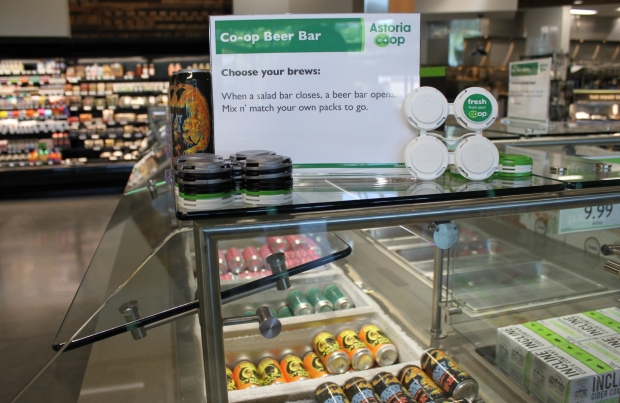
For those wondering how to get the most out of an underutilized salad bar, look to Astoria Co+op in Oregon. They’ve converted their salad bar into a staging area for local beers. Customers can mix-and-match and create their own six- or 12-packs from the display. Astoria’s marketing director Zetty Nemlowill recalls walking by the salad bar and thinking how sad it looked empty. “We had some case stacks of beer next to it, and I thought we should be merchandising that beer in the cold wells,” she says. Nemlowill brought up the idea with the co-op’s beer and wine buyer. They discussed a plan to focus on single cans of highly coveted seasonal craft beers and allow shoppers to mix and match their own packs.
“It’s an especially interesting time to do this, because some breweries that only did draft sales were forced to start packaging their beers when restaurants and bars closed,” Nemlowill says. “We got some reusable toppers from a local brewery and I designed a sticker to go on the toppers.”
Concern for Community
Bloomingfoods Co-op Market in Bloomington, Ind., recognizes that community and gathering are essential to who they are and what they do. To acknowledge this, they launched “Taking Care of Each Other,” a page on their website where people can share stories of community and support. Users share recipes, what they’re reading, cooking or watching, and how they’re staying connected and taking care of themselves during quarantine. The staff at Bloomingfoods compiled the submissions, which were published in their newsletter.
BriarPatch Food Co-op in Grass Valley, Calif., created a “Helping Our Heroes” campaign. Every week, the co-op donates food and supplies to members of their community who are going the extra mile. Examples of donations include food to a local food bank, 300 pounds of chicken to a community shelter, free pet food to an animal shelter, and burritos and coconut water to area medical workers.
Co-ops are responding to the COVID-19 pandemic in new and creative ways. Each co-op is unique and there are no one-size-fits-all solutions. Still, consider whether you may be able to adapt some of these ideas at your co-op. At the very least, we hope these short profiles will spark inspiration for new strategies to serve the changing needs of your owners, customers, vendors and community.